


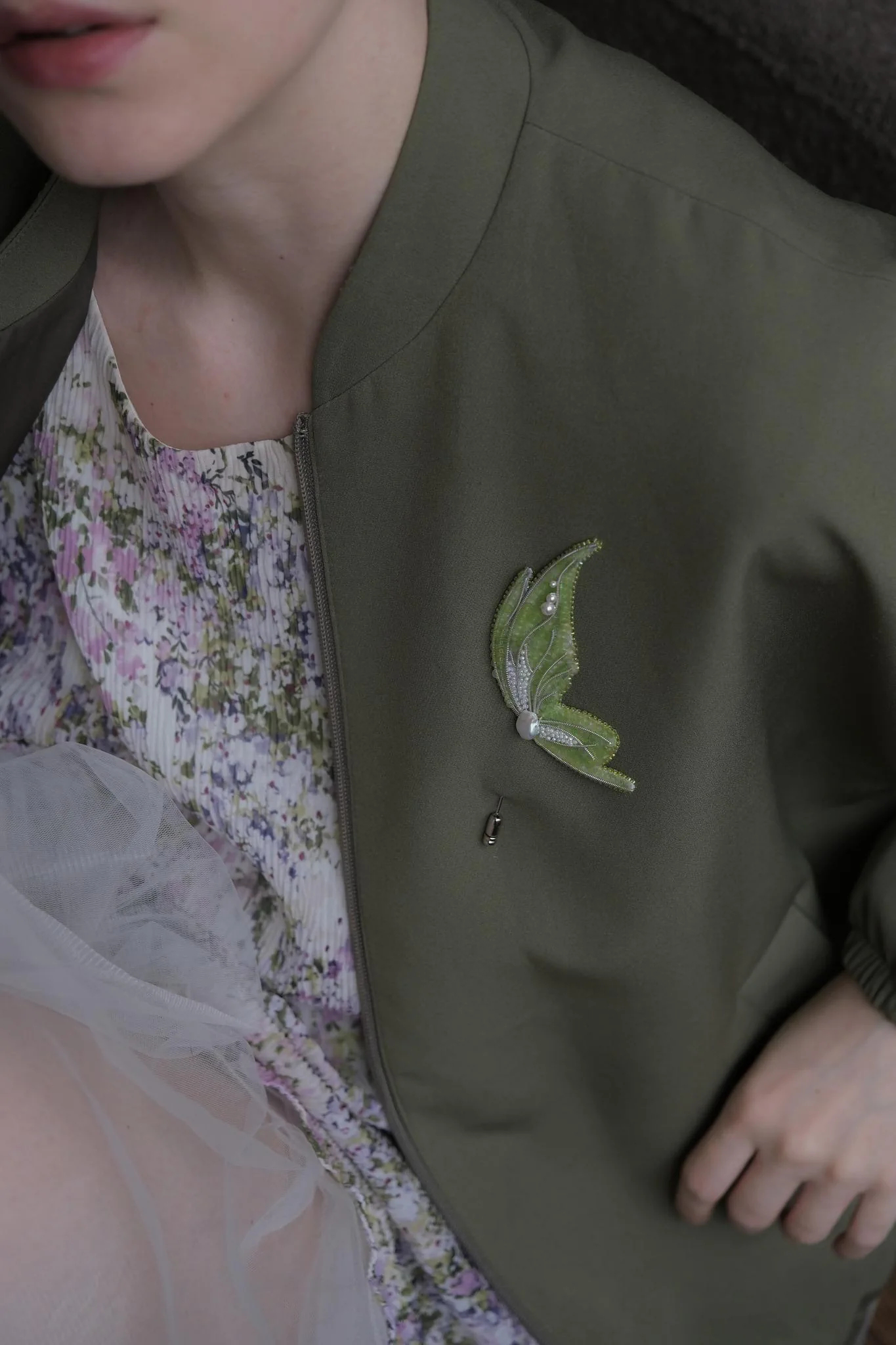
Handmade jewellery rewards attention at several distances. From across a room, you see a recognisable image: a flower, a wing or a leaf. Closer up, lines guide your eye across the surface. At the smallest scale, individual elements become part of the picture. Looking in this way can help you understand what drew you to a piece and how you would enjoy wearing it.
Find the main line first
Place a photograph of the jewellery beside a picture of an outfit, or hold the piece against a plain fabric. Look at the outline before focusing on individual beads. It may be rounded, elongated, sharply defined or shaped like a freely curving plant.
Fairy Wing has curved lines and elongated parts that suggest movement. On a jacket, those lines can follow the lapel or turn gently away from it. Rotating the piece slightly changes its direction within the whole arrangement.
Notice the rhythm of smaller elements
Move closer and find the repetitions: a row of beads, neighbouring curves or areas of a shared colour. Follow one line from beginning to end. It might frame the edge or divide the shape into smaller sections that only become apparent nearby.
The description of this brooch lists Italian sequins and Japanese jewellery beads. In the photograph, you can compare their surfaces within the same embroidery. Some areas appear as a fine, grain-like pattern; others give broader reflections. Together, they create several different scales of detail.

Watch what the light changes
Slowly change the angle of the piece beside a window. Ordinary diffused light is enough to begin exploring it. Notice which areas remain visible throughout and which catch your attention only when the jewellery turns.
When choosing from a catalogue, compare a full view, a close-up and a photograph of the piece being worn. They provide different information. A close-up shows the pattern, while a photograph with clothing helps you judge scale. Screens and photographic lighting can affect the appearance of colour, so check material details in the description as well.
Choose a fabric for your favourite detail
Decide what you would like to emphasise: the outline, the colour or the fine embroidery. A smooth, plain background makes all three relatively easy to see. A textured fabric adds a pattern of its own, inviting you to find a connection through a line or a shared shade.
In the photograph, the brooch sits against a quiet green area beside a smaller floral clothing pattern. This gives the jewellery a clear place within the outfit, with more complex texture nearby. For your own garment, choose fabric suited to the piece's weight and fastening.
Ask specific questions about the piece
Before buying, check the size, materials, fastening and the maker's recommendations. If a particular side of the jewellery or part of the attachment matters to you, ask for another photograph. One attractive overall image may leave some practical details out of view.
Keep a personal observation too: an unusual shade, a beautiful curve or the meeting of two surfaces. That detail can become the starting point for a future outfit. Getting to know a piece closely gives you more reasons to return to it in your everyday wardrobe.
Comments
Questions, observations and useful additions from readers.
New and edited comments appear after moderation.
Start the conversation
Be the first reader to leave a thoughtful comment.