


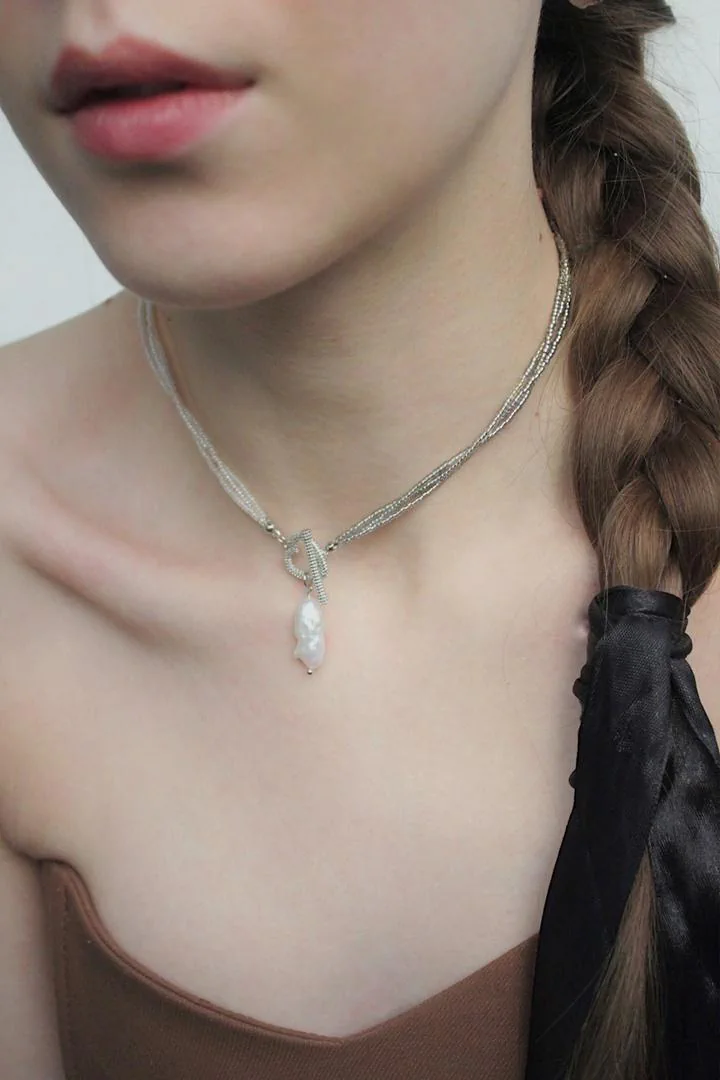
An October wardrobe often comes together in layers: a shirt, a jumper, a jacket and a coat. Jewellery can form a smaller composition within that arrangement. A short line near the neck marks its upper edge, while a longer pendant carries the eye downwards. Begin by noticing where those lines meet your clothes and one another.
Start with one neckline
Choose the top you intend to wear. An open shirt gives the jewellery a space between two collar edges. A round neckline contributes a curve of its own, while a V-neck creates a downward line. Look at this shape before adding a second necklace.
Put the shorter piece in its usual position. Then hold the longer one in place and see where its pendant lands: against skin, over fabric or exactly at the neckline. If it keeps disappearing behind the edge, try another length or another top. The position should work when you move as well as when you stand still.
Leave a visible gap
Two lines are easier to appreciate when a little space separates them. There is no fixed measurement to follow: the gap depends on the size of the beads, the pendant shape and the neckline. Step back from the mirror and check that you can still distinguish the pieces.
If the choker already has a central drop, include its lowest point in the arrangement. The Oyster choker's shaped fastening and pearl make a complete composition of their own. You could begin by adding a simple longer chain, then decide whether it needs a pendant too.

Give the details different roles
One necklace can contribute texture while the other provides a distinct shape. Several fine beaded strands form a soft band; a separate smooth pendant supplies a clear point beneath it. Giving each piece a role makes the overall combination easier to see.
The materials do not have to match throughout. Look for one connection, such as a pale colour, a rounded outline or a similar metal finish. If you enjoy more complex combinations, add each new detail gradually so you can see what it contributes.
Add your outer layer
Put on the cardigan or jacket and check whether the jewellery remains visible. Open edges can frame the arrangement, but they may also hide its central detail. The point where you fasten a cardigan changes the space available too.
Sit down, lean forward and turn your head. Chains can cross as you move. Different lengths help separate them visually, although they cannot guarantee that the pieces will never tangle. If you find yourself constantly adjusting the combination, change the pairing or wear one necklace on its own.
Find a pairing you can repeat
Two pieces you already know are enough for the first experiment. Try them with one top and then another. The same pair may work differently inside an open collar and over smooth fabric, giving you two versions to return to.
Save a photograph and note the chain length or fastening position you used. Those small details make the arrangement easier to recreate in the morning. Over time, you can build a few familiar combinations that fit your autumn clothes and feel comfortable during an ordinary day.
Comments
Questions, observations and useful additions from readers.
New and edited comments appear after moderation.
Start the conversation
Be the first reader to leave a thoughtful comment.